
The Illusion of the Majority
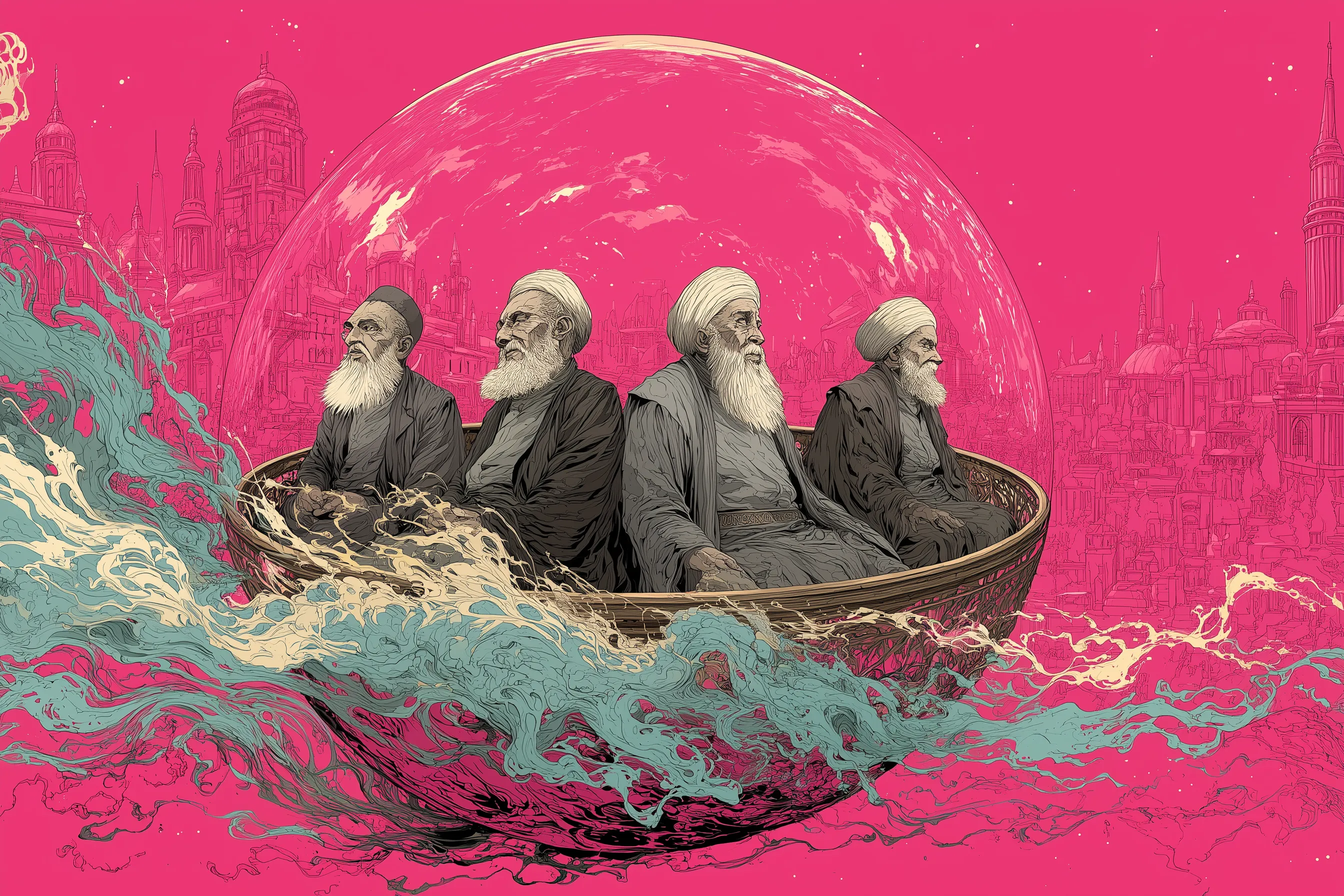
TL;DR
This essay critically examines a common argument in Muslim discourse, the appeal to "the majority", which is often used to dismiss differing views without examining them on their merits. It shows how logical fallacies and a selective reading of history turn a snapshot of the 19th century into a supposed timeless tradition. The essay also pushes back against familiar counterarguments such as theological consensus or the fear of being too "Westernised", and shows that rationality is deeply rooted in Muslim intellectual history. In the end it argues for recognising the real diversity inside the Muslim world, rather than wielding an imaginary unity as a tool of power.
Why We Should Talk With Each Other More Openly
Anyone who joins a conversation among Muslims today and voices positions that depart from well known narratives, or that come across as less strict, rarely meets a real engagement with the substance of the argument. Instead of testing the strength of the reasoning, some critics react with personal attacks. They question someone’s qualifications or attack their credibility.
A striking move is the quick appeal to “the majority of scholars” and to the Muslim tradition. On the surface this gesture looks strong. But it actually reveals another problem. It replaces argument with deference to a large group. That is a logical mistake, and it usually rests on an idealised picture of history that doesn’t survive close scrutiny.
The result is the impression that many participants are less interested in finding solutions or in “truth”, and more interested in preserving a certain state of affairs. The appeal to a supposedly unified majority then functions like a shield against difficult questions. In this way, real development gets blocked. For conversations to become genuinely constructive, we have to recognise these patterns. We need to understand how authority arises, and why the sheer number of followers is not a valid argument when we’re talking about meaning, rules, plausibility, or even “truth”.
The Logical Fallacies
The argumentation of so called neotraditionalism leans heavily on three classical thinking errors that often kill a real debate before it can begin. The first, and probably the most persistent, is the argumentum ad populum, the appeal to the numerical superiority of an opinion. A fundamental category error happens here. Instead of testing the arguments offered by a majority for their soundness, the mere existence of the majority is itself treated as the proof. It is claimed that a statement is true simply because many people believe it. This overlooks the fact that truth or plausibility is not a democratic decision settled by a show of hands. History is full of cases in which huge majorities were collectively wrong, until their assumptions were refuted. Anyone appealing to the majority often dodges the intellectual responsibility of showing on substantive grounds why this majority should be right. The number of followers says nothing about the quality of the teaching. It doesn’t replace evidence; it merely serves as a social tranquilliser.
Second, we often meet the argumentum ad verecundiam, the appeal to authority. Here a person’s status alone is treated as proof that a statement is true. But experts make mistakes too. Their authority has to rest on the plausibility of their data and arguments, not on a title or a social position alone.
Third, the argumentum ad antiquitatem shows up a lot, the appeal to tradition. This argument implies that a practice is right just because it has existed for a long time. Moral and social development, however, requires the constant questioning of older habits. That is the only way knowledge can deepen and social practice can improve.
These three fallacies often form the ground on which resistance to new thinking is built. Once they are exposed as fallacies, the neotraditionalist position loses much of its persuasive force. It becomes clear that tradition alone cannot be an argument for the correctness of an action or a belief.
The Construction of “Neo Tradition”
A central problem in the debate is the ahistorical assumption that “the majority of scholars” is an unmoving constant, stretching from the time of the Prophet in an unbroken line. This is an illusion that doesn’t hold up to historical scrutiny. Theological positions have always been in flux. What counted as a minority opinion in one era became doctrine in another, and the reverse. What we today call “Islam” or “the Sunni tradition” is often nothing other than a canonised snapshot of the 19th and early 20th centuries, falsely projected as timeless.
In today’s curricula, theological opinions, and even in clothing, there is a determined effort to preserve this specific historical period. This is a kind of “neotraditionalism” that elevates a selective past into an absolute norm. It imitates the aesthetic of tradition, but often refuses its actual intellectual core: the dynamism and capacity for adaptation that earlier centuries showed. Instead of using tradition as a tool for solving problems, it becomes a museum piece of stubborn preservation.
This construction also suffers from a deep geographical and cultural narrowing. When the discourse speaks reverently of “the scholars”, what is almost always implicitly meant is the region of West Asia and North Africa. Muslim scholarship in West Africa, the networks of knowledge in Southeast Asia, and the historical traditions in China are systematically left out or treated as “peripheral Islam”.
When you ask representatives of the supposed majority position to name even five major scholars from Nigeria or Bangladesh on the spot, the answer is often awkward silence. The “true teaching” is mistakenly equated with the politically loudest region, while the global diversity of Muslim life is ignored. This badly distorts the picture of what is actually thought and lived in Muslim communities, and frequently confuses regional cultural hegemony with a universal theology.
Structural Change and the Fear of Losing Identity
A common accusation against new approaches sounds like this: “Have Muslims been wrong for 1400 years?” This is a straw man. Nobody is claiming that earlier generations were wrong across the board. Their positions were answers to their specific life world, which was that of an agrarian society. But the industrial and digital revolutions have changed human existence more radically than all the millennia before them. Views that made sense in a premodern world have to be tested today for their relevance.
Of course, against such change a theological objection is often raised: that consensus (iǧmāʿ) is a binding source of law. People point to the tradition that says the community “will not agree on an error”. On closer inspection, though, this absolute consensus often reveals itself as a theoretical ideal that was rarely tangible in history.
Equally reflexive is the accusation that any form of rethinking or any new approach is a surrender to “the West”, or an import of the Enlightenment that threatens Muslim identity. This ignores the fact that rationality is not a Western patent. It was deeply rooted in Muslim intellectual history. An identity that can only protect itself by denying reality and conserving outdated structures is a fragile identity.
The Silent Majority as an Instrument of Power
The appeal to the majority today often serves as an instrument of power, used to enforce conformity and delegitimise dissenting voices. Questions like “Who are you to disagree with the majority?” are meant to intimidate. But where does the knowledge about this majority actually come from? Empirical data showing what the majority of Muslims worldwide actually think or practise is missing.
Instead, wishful thinking is projected onto an imaginary mass. This resembles the methods of essentialists and right wing radicals, who assign blanket characteristics to all Muslims. Anyone speaking today in the name of the majority often claims the voice of those who are perhaps not silent at all, but who have been structurally silenced.
An empirical study would likely show that the reality of Muslim life is far more colourful and heterogeneous than the neotraditionalist utopia allows for. There are countless ways of living a Muslim life that find no place in the rigid grids of the loudest voices. Recognising this diversity would be a first step toward honesty.
The times when one could speak unchallenged in the name of a silent majority are over. We have to learn to live with ambiguity and to understand discourse not as a threat, but as a source of richness. Only on that basis can a living and future ready theology develop, a theology that serves human beings here and now.